How people manage their cryptocurrency portfolios in 2025 certainly differs significantly from some years back. In the early times, an ordinary Excel sheet or an exchange- single wallet page sufficed for holding track. Now, with numerous blockchains, as many as dozens of exchanges, as well as an onslaught of fresh assets, the software investors depend on has turned greatly advanced. What was once just some few dozens of dashes has evolved into some combination of automated setups, dual platforms, as well as institutional-level applications.
This growth didn’t occur overnight. Decentralized finance’s rise, entry by old-guard institutions, and tax regulation complexity encouraged investors toward boutique-style services. Rather than making an educated guess, traders today require precision in the calculation of ROI as well as PnLs, where fund managers desire automation cutting down on the human touch. What emerges is the tiered landscape where platform types coexist side by side — the bare-bones entry-level dashboard all the way through professional suites combining automation, compliance features, as well as analytics.
How dashboards started as the investors’ entry point
Dashboards were the point of entry for most neophytes. They provided an single page with balances, prices for the market, and basic performance graphs. To an individual who held Bitcoin, Ethereum, and perhaps an altcoin or two, this sufficed.
It was not so different for the 2018 normal dashboard.
| Feature | What it had then | How it developed today (2025) |
| Stance overview | Manual entry or API connection | Real-time synchronization of different chains |
| ROI/PnL display | Simple “green or red” indicator | Detailed trading record per transaction |
| Asset coverage | Primarily top 10–20 coins | Thousands of tokens, non-fungible tokens, DeFi |
| Accessibility | Virtual dashboard only | Mobiles, widgets, voice assistants |
Dashboards made entry less intimidating due to familiarity: single sheet of paper, some numbers, simple charts. But as soon as users began messing about in DeFi or actively trading, they hit their limit. No dashboard handled staking returns, yield farming, or elaborate tax events without higher-level mechanics.
“The moment I attempted tracking the liquidity pool position by hand, I knew I required something more than a nice-looking graph. It was all well and good for the dashboard but my actual returns deferred faringly far.” — Retail investor anecdote, 2023
Why automation redesigns the expectation in today’s marketplaces
By 2025, automation isn’t an afterthought feature — it’s the rule. Consumers desire their portfolios refreshed on the fly after executing a trade. Professionals require bots to reconcile thousands of transactions per day. And regulators require reports primed for regulators at the touch of a button.
Think about three investor archetypes:
- Casual holders: Primarily desire updates on balances and straightforward return on investments.
- Active traders: Expect automatic PnL calculation, position sizing, and risk alerts.
- Institutions: Need audit-ready files, API connections with custodians, as well as tax jurisdictions compliance.
Automation fulfills all these requirements by automating the work. For instance, rather than programmatically entering 200 trades into the spreadsheet, the trader interfaces exchange APIs and wallets; the system straightens out the deposit/withhold staking reward/fail thru.
An illustration of side-by-side comparison between automation and human dashboard monitoring:
| Dimension | Manual dashboard | Automated system (2025) |
| Speed of updates | Delayed, often manual | Near-instant using API/web3 feeds |
| Precision of ROI/PnL | Prone to human fallibility | Algorithm-controlled, trade-level specifics |
| Tax preparedness | Needs additional software | Built-in calculation engines |
| Scalability | Works for small wallets | Processes hundreds of transactions |
It has also affected investor psychology. Once you get accustomed to automated reconciliation, it’s not easy to revert. The promise of the “always-right numbers” alters the way investors hold platforms accountable. A slow or partial dashboard now comes off as retrograde, although it may be aesthetically pleasing.
Important Factors for Selecting Management Styles
Choosing a method of managing a crypto portfolio in 2025 isn’t about ease anymore. Investors consider several factors before choosing between an auto-platform or the use of a simple dashboard for their circumstances. Four factors rule the consideration: accuracy for the reporting of ROI/PnLs, ease of use for the person, level of data security, as well as costs. Each has trade-offs behind them explaining why different communities tend toward different options.
Precision and accuracy of ROI/PnL estimates
Monitoring Return on Investment (ROI) as well as Profit and Loss (PnL) lies at the heart of portfolio management. It may seem adorable aesthetically but when its arithmetic go wrong the client loses credibility fast.
Dashboards generally offer a snapshot: current versus money invested. But the moment staking rewards, airdrops, or liquidity pool tokens are involved, mistakes intervene. Automated programs, however, calculate all transactions, labelling them as unrealized or realized gains.
Comparison example:
| Scenario | Dashboard style | Automated approach |
| Spot trading (10–20 trades/month) | Manages well | Manages nicely |
| Revenue farming incentives | Regularly overlooked | Logged and added in ROI |
| Multichain swaps between chains | Difficult to monitor manually | Auto-recognized by on-chain data |
| NFT income-based | Infrequently included | Incorporated in higher trackers |
A small investor may not care about some imperfections but after tax time sets in or the income increases, accuracy becomes unacceptable.
User experience: simplicity vs. complexity
Not all users desire the same degree of detail. New users tend to yearn for simplicity — simplistic charts, an envelope line, perhaps a pie chart of portfolio allocation. To them, additional metrics become intimidating.
Compared to traders, traders require multi-level views — history of trade, risk statistics, order books, and sophisticated charting. Some use several monitors so it all stays in sight. The balance between simplicity and sophistication characterizes much of the rivalry between automateds and dashboards.
“The interface should lead me, not swamp me in options I won’t ever use. But should I choose to go deep, those tools had darn well better be available.” — Active trader comment, 2024
It’s hard to strike the right balance between both. Some sites attempt to provide toggle modes: beginner mode/view and professional mode/analytics. It sounds nice on paper but in reality the second mode tends to feel less developed.
Data security and control in various models
Crypto management involves trusting. Giving away API keys or linking wallets makes users anxious, and they have all the right. Dashboards based on manual entry don’t see this problem but compromise on accuracy. Automated platforms, on the other hand, may ask for read-only API keys reducing the risk but posing the issue of the central storage of data.
Normal security trade-offs:
- Manual gauges → No exposed keys but accuracy relies on keyboard entry.
- API-enabled automated trackers → Precision and convenience at the sacrifice of cryptic keys needing secured hosting.
- DeFi-native integrations → In-wallet integrations; perfect for being transparent but may reveal the metadata.
Institutional users must meet higher requirements: standards for encryption, audit logging, and GDPR- or SOC2-compliance. A tool passing these verification tests won’t be taken into consideration however rich it may feature.
Cost-effectiveness: when the dashboard will do and when automation will reward itself
Money never matters. In the end, an all-you-can-pay-for dashboard might suit an individual holder of a few hundred worth of cryptocurrency just fine. But as portfolios grow larger, underlying charges manifest: time wasted fixing mistakes, paying accountants to reconcile tax data, or forgoing moneymaking opportunities because the numbers are stale.
Let’s break it down:
| Portfolio size | Best fit | Why |
| <$5,000 casual holding | Free dashboard | Low activity, regular structure |
| $5,000–$50,000 active user | Hybrid or starter-level automation | Precision for saving time and stress |
| $50,000+ trader/fund | Full automation with reporting | Scale requires speed and accuracy |
For professionals, the cost of subscription usually dwarfs the risk of faulty data. It becomes paltry spending $20–50 per month when it could prevent hundreds of dollars of tax mistakes or trading losses.
Comparative Analysis of Portfolio Management Trackers for 2025
Portfolio tracker market and automated system marketplace has evolved into a multiplicitous ecosystem. Consumers now compete amongst hundreds of offerings hyping speed, accuracy, and simplicity. But all the offerings don’t tackle portfolio management similarly.
1. CoinDataFlow
https://coindataflow.com/en/portfolio-tracker
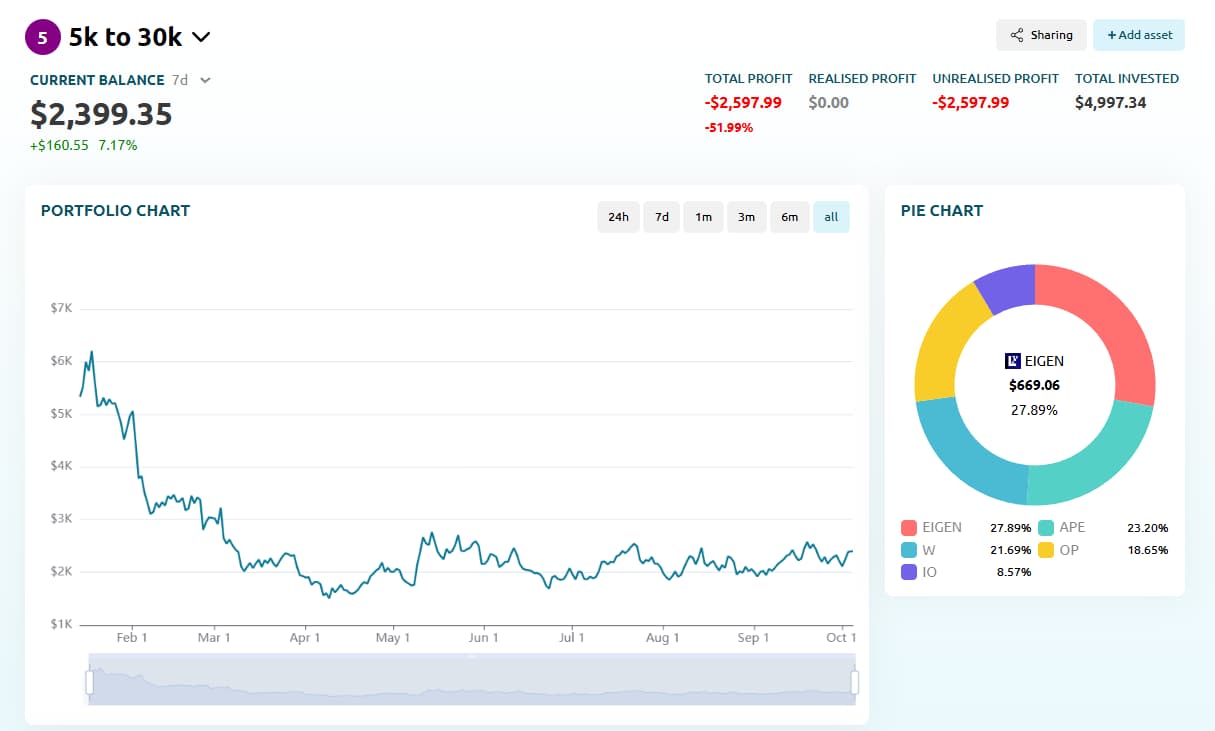
CoinDataFlow sits between the realm of straightforward dashes and the advanced automation. While most of the competitors swing too hard for the extremes — providing entry-level friendliness of balance reviews or professional-level data suites — CoinDataFlow balances between.
Unify view: dashboards supplemented using automation components
It initializes on a blank overview page just like any person who has had the pleasure of using a balance tracker before. But behind the simplicity lies automation. APIs for exchange feeds connect wallets so you see live data without the hassle of manual entry for something as intensive as swaps, staking returns, or liquidity farming.
Example: A dealer shifting between Ethereum and Layer-2 networks gets combined exposure in the single chart. Rather than switching between three different dashboards, CoinDataFlow presents aggregated data refreshed in real time.
Transparency in ROI/PnL and integration with live market
Where most dashboards fail, CoinDataFlow excels at accuracy of ROI and PnL. Benefits as well as losses aren’t depicted as some unreadable “overall balance” but itemized by trade, money asset, and time frame.
Sample breakdown (user view):
- Current portfolio value: $18,420
- Invested capital: $15,300
- Realised profit: +$2,100
- Unrealized PnL: +$1,020
- ROI (since inception): +21.5%
These figures come straight from synced transactions, not estimates. It ensures that even when tax season comes around, users already have data organized and waiting for export.
Well-balanced stand between basic and sophisticated features
What sets CoinDataFlow apart from most competitors is the capacity for it to scale with the individual. A newbie can go as far as the primary dashboard and introductory graphs, but an active trader may go as deep as advanced analytics panel switching, past performance, and cross-exchange monitoring. Unlike institutional offerings where retail holders feel abandoned, or dashes where hardcore users feel held back, CoinDataFlow accommodates both extremes.
“I needed something my younger brother could use without tutorials but robust enough for me to study everyday trade. CoinDataFlow turned out the compromise.” — Comment by semi-professional trader, 2025
Another advantage is price flexibility. Instead of gating all the advanced features behind high monthly fees, the service takes the tiered approach. It enables small holders to access it for free whereas professionals pay for the additional automation and export functionalities.
2. CryptoCompare
https://www.cryptocompare.com/portfolio/
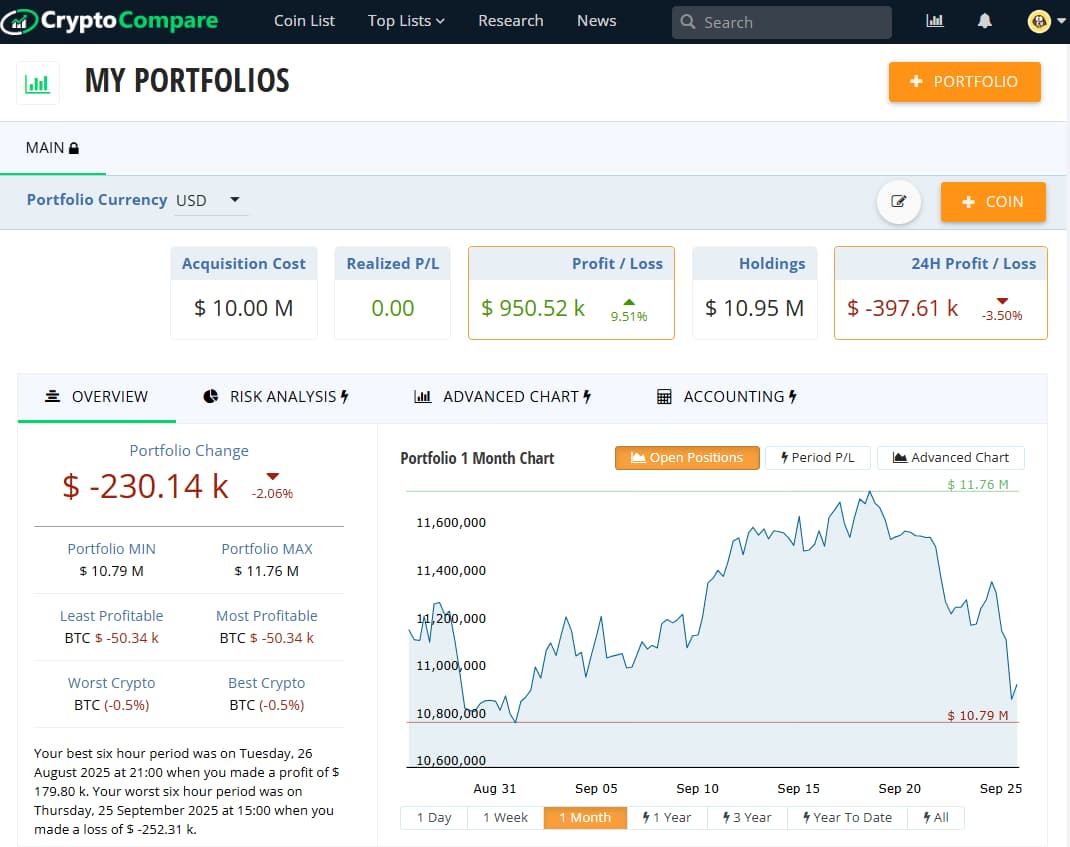
CryptoCompare has been in existence for years as mostly data aggregation and market analytics. It later branched into portfolio tracking providing dashboard-like solution for casual as well as intermediate users. Its point of strength lies in familiarity as well as market data width but weaknesses show up once automation turns into necessity.
Simple access for new users using dashboards
It feels easy for newbies. The dashboard design is straightforward: balances, allocation graphs, and news feed for market all in the same window. Most users encounter it for the first time when looking for prices for coins and then stumble upon the portfolio facility. It takes little time for onboarding — entry by hand or simple exchange connectivity, all set.
Example of beginner vision:
| Feature | What user sees | Value for starter |
| Portfolio balance | Total $ value + chart | Immediate feeling of magnitude |
| Asset allocation pie | BTC, ETH, remaining % | Simple way for visualization of holdings |
| Market feed | News + prices movements | Context without departing platform |
It is this blend that justifies why CryptoCompare remains fashionable among amateur investors who don’t trade on an everyday basis but desire to “keep an eye” on their holdings.
Fewer depths in automation and pro analytics
The downside emerges when activity increases. Automated reconciliation stays superficial: major exchanges reconcile well but multi-chain DeFi transfers, NFT income, or advanced staking payments tend to disappear. Manually entries need to be corrected by the users, which gets cumbersome.
As professionals, the analytics sound dated. There’s ROI/PnL, but not at trade levels. Reports don’t provide the level of granularity needed for taxation in several jurisdictions. CryptoCompare becomes too big for people’s britches for most active users — too useful at the starting point.
“I began on CryptoCompare as it felt well known, however, once I had more than two adjusts intertwined, the cracks began to appear.” — User comment, 2024
3. Kubera
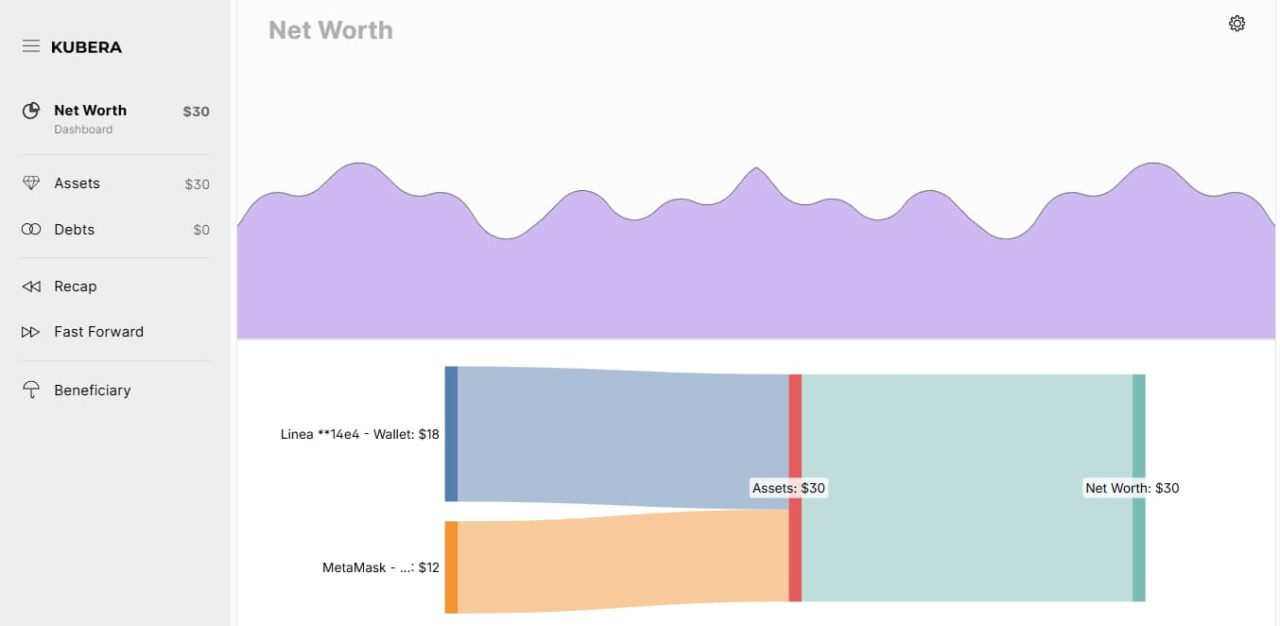
Kubera takes portfolio management in an entirely different way: it’s not exclusively crypto but takes the combination of tokens along with regular investments. For users who not only hold tokens but also stocks or property or even non-fungible tokens or perhaps even collectibles, Kubera offers the promise of the “single wealth dashboard.” It makes it appealing for diversified investors but also reveals certain shortcomings when compared to the crypto-native platforms.
Hybrid methodology spanning over crypto and conventional assets
Unlike some trackers that only track blockchain-based holdings, Kubera interfaces directly into brokerage accounts, bank feeds, as well as property valuation APIs. An individual can access their site and view their ETH balance as well as the current estimated value of their Tesla holdings, along with the value of their residence.
Example snapshot from a Kubera user’s mixed portfolio:
- Crypto (BTC, ETH) → API exchange & wallets → $42,300
- Stocks (Tesla) → Brokerage account syncing → $18,750
- Real estate (condo) → Zillow/value calculation → $145,000
- Bank account (USD) → Open bank integration → $12,600
For those who cross-asset classes, it is an easy view. It eliminates time clicking between apps as well as gives an overall image of net worth.
Pricing model and absence of automation for crypto-natives
Kubera’s weakness reveals when activity is extremely biased toward crypto. Its automation depth is shallower relative to DeBank-style platforms. Yield farm positions, NFT royalties, or DeFi token vesting schedules tend to need frequent manual adjustments, making the tool less applicable for professionals or for users who pay taxes.
Another issue is cost. Kubera operates on a subscription basis at around ~$150 per year or higher, making it expensive for customers who don’t require coverage on multiple assets. While tolerable among high-net-worth customers who treat cryptocurrency as just another slice of their larger portfolio pie, it discourages younger or cryptocurrency-only investors who would pay less for entry.
“Kubera gave me the complete picture of my portfolio but when I needed to dissect staking returns, I still had to run an Excel spread sheet.” — Investor commentary, 2025
4. Coinigy
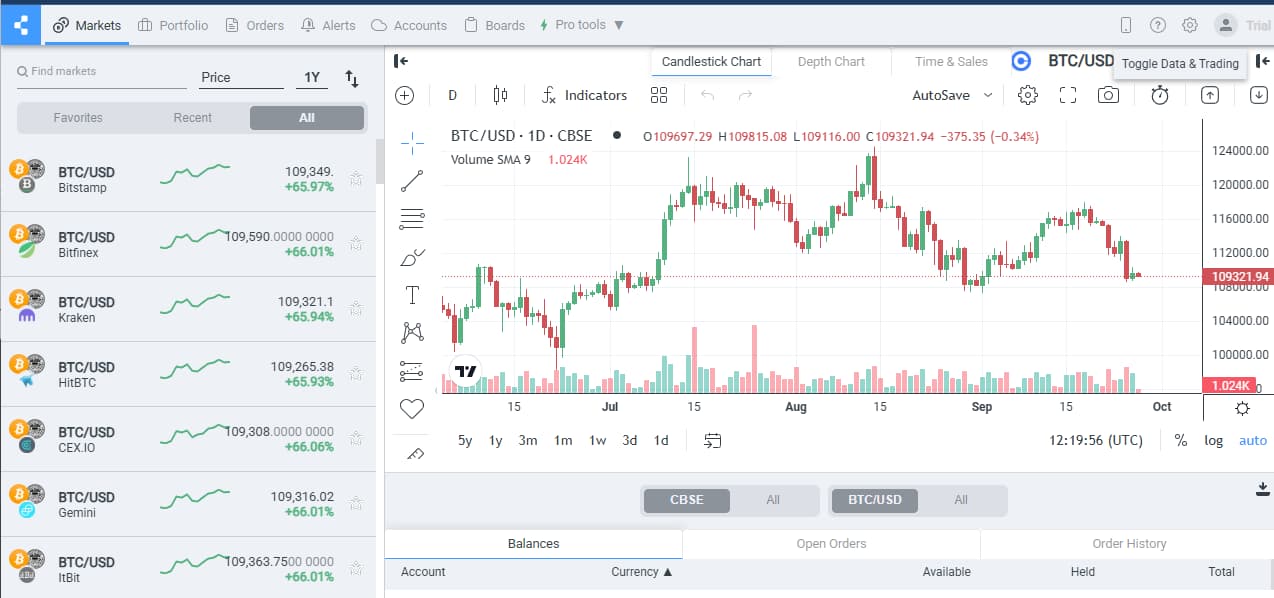
Coinigy was long touted as the multi-exchange dashboard, allowing traders to link multiple accounts and track them on a single dashboard. It was popular some years back when active traders had an immaculate way of viewing the holdings on multiple exchanges at the same time. Although it still serves well in 2025, the development of the software hasn’t caught up with the newer automated tracker wave.
Multi-exchange dashboard emphasis
Its big advantage is aggregation. An individual connects several exchange APIs and receives balances, charting for prices, and allocations all at once in the single panel. For those who don’t enjoy juggling five tabs, Coinigy decreases friction.
Traders’ overview window generally appears as follows:
- Binance → 1.2 BTC → $72,000 → 60%
- Kraken → 3 ETH → $9,600 → 8%
- Coinbase → $12,500 → $12,500 → 10%
- KuCoin → Various alts → $25,800 → 22%
It suits centralized exchanges where the majority of the activities run on spot or margin trade. It suffices for users who scratch the surface only occasionally.
Fears about old UX and subscription-based models
It gets problematic in 2025 when newer expectations kick in. Coinigy’s UI was once streamlined but now looks aged compared to competitors’ modern UI and modular customization. There are files available for reporting on ROI and PnL but not in-depth ones; auto-reconciliation for sophisticated trades is not available.
Another point of frustration is the pay model. Coinigy levies monthly fees that add up fast, while most competitors offer freemium levels or tiered fees scaled with utilization. For hobbyist traders, this makes Coinigy seem pricy compared to the value proposition.
“Coinigy assisted me when I had accounts on five different exchanges at the time, but when I transitioned into DeFi, it was unable to cope.” — Ex-user testimony, 2024
In brief, Coinigy still qualifies as an adequate choice for exchange-centralized trade but falls short of complying with users who require both automation as well as wider asset coverage.
5. Nansen Portfolio
https://www.nansen.ai/crypto-portfolio-tracker
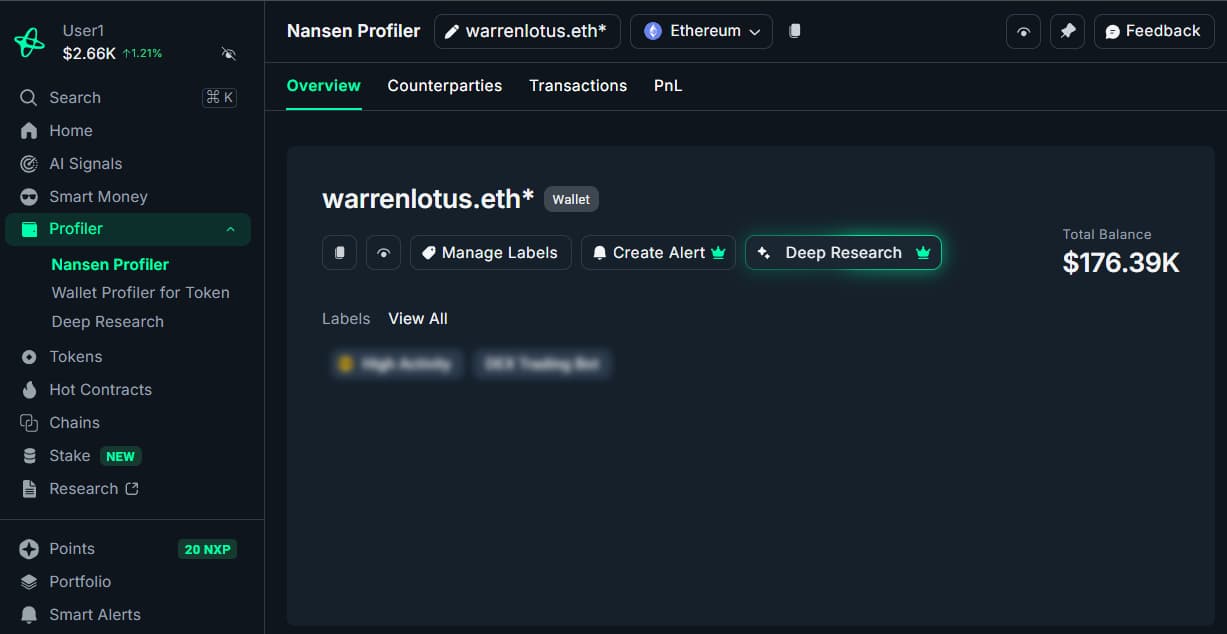
Nansen Portfolio walks in from the crypto analytics side. It is built upon the robust blockchain data infrastructure of Nansen but leans greatly into on-chain intelligence. Rather than displaying balances alone, it supplies context: who also owns the tokens, how the smart money wallets are moving, as well as possible risks. To data-inclining investors, it’s the holy grail. To casual users, it feels overwhelming and expensive.
Data-driven automation and on-chain intelligence
While most dashboards limit themselves at balances and ROI, Nansen Portfolio takes transaction-level insights straight from the blockchain. It can label addresses as whales, funds, or exchanges, then display how those groups deal with the assets.
Example: consider you hold a mid-cap DeFi token. Nansen can point out that 40% of liquidity is concentrated among the top ten wallets, or how the “smart money” has been subtly decreasing exposure. This shifts the tool from being just a tracker to a decision-support system.
Feature set (Nansen Portfolio provides):
- Address Labelling → Identifies whales, exchanges, funds
- Smart money alerts → Alerts when pro wallets purchase/sell assets
- Portfolio display → ROI, PnL, and allocation synchronized
- Risk measures → Liquidity concentration, holder activity
This type of automation provides traders with instant, actionable insights, merging tracking together with market intelligence.
High expense and sophistication for retail users
The downside is affordability. Nansen Portfolio is costly, considering its enterprise data pricing. For the retail client who holds a few thousand dollars, paying hundreds per year feels disproportionate.
The interface also leans toward analysts. Charts, tables, and network graphs may overwhelm someone who only wanted to check “am I up or down this week?” The learning curve is steeper compared to dashboards like CoinGecko Portfolio or CoinMarketCap Portfolio.
“Nansen revealed to me patterns I never would’ve spotted on my own but made me feel as if I required a data science degree to fully understand it all.” — User comment, 2025
For professionals, however, the additional depth finds its reward. Players seeking alpha or risk management find Nansen Portfolio an effective co-pilot. But for the average daily user, it is too costly and cumbersome as a mainstream choice.
6. DeBank
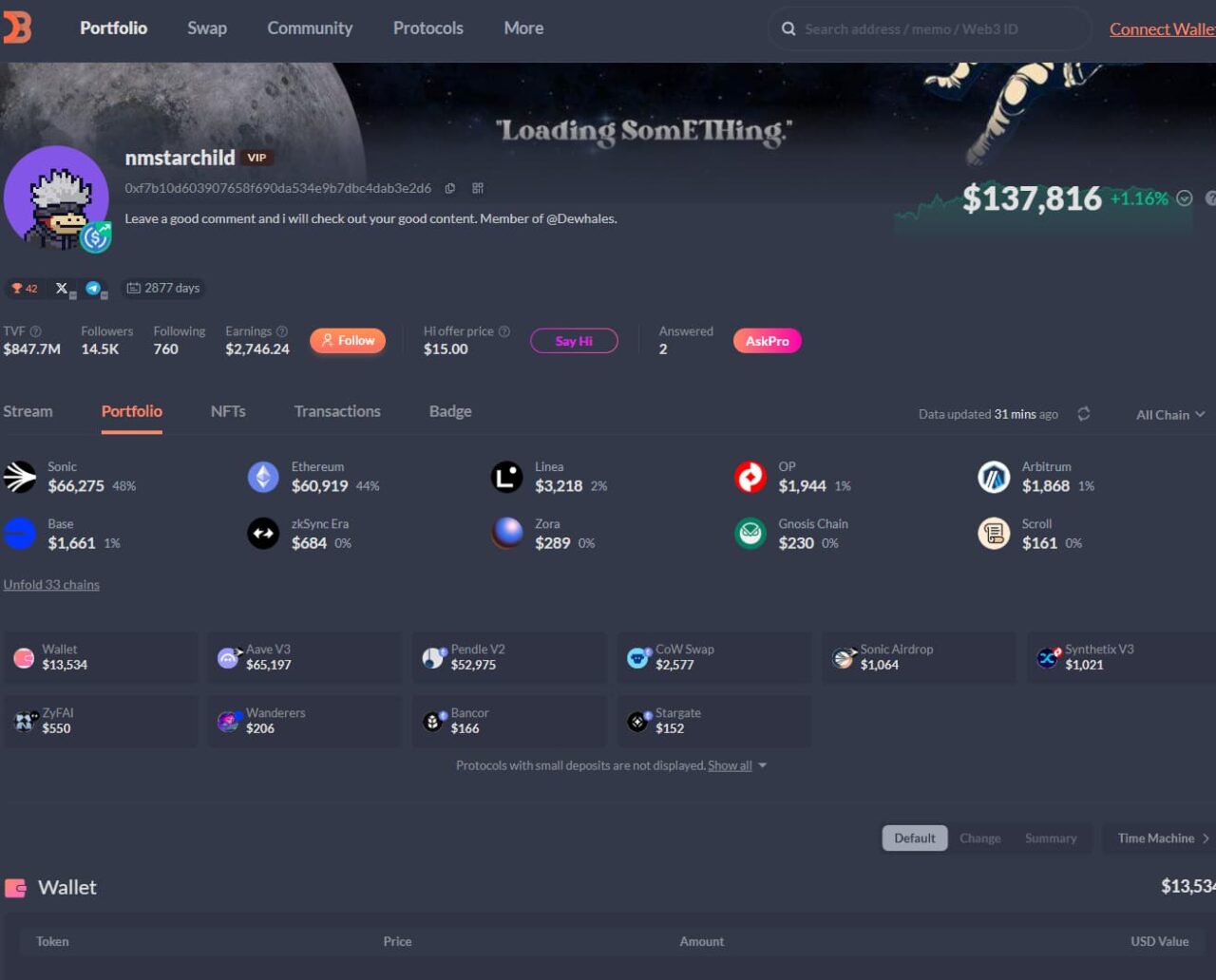
DeBank is often described as the “DeFi-native dashboard.” Instead of focusing on centralized exchanges, it dives deep into decentralized finance ecosystems, pulling live wallet data directly from on-chain sources. For users active in yield farming, lending protocols, and governance tokens, DeBank provides a tailored view that most general trackers cannot match.
DeFi dashboard integrated with some automation levels
Unlike dashboards where inputs need to be fed by hand or where only limited numbers of API keys may be used, DeBank directly connects through wallets like MetaMask. Upon connection, it simultaneously lays out assets spread across numerous DeFi protocols — lending positions, shares in liquidity pools, governance tokens, and claimable rewards.
Example of a DeBank DeFi portfolio snapshot:
- Aave → Lending collateral → $12,400 → Active
- Uniswap V3 → LP tokens → $8,750 → Providing liquidity
- Curve Finance → Stablecoin pool → $5,300 → Rewards due
- Compound → Borrowed capital → -$2,200 → Open debt
Such automatic detection implies the users don’t need to manually add DeFi interactions — a major plus over older dashboards.
Specific application for centralized exchange portfolios
But the platform’s strength is also its flaw. DeBank doesn’t give much attention to balances on centralized exchanges. An active trader on Binance or Coinbase might not find the tool complete because the assets don’t mirror each other seamlessly. DeBank thus functions best as a secondary tracker: perfect for DeFi transparency but not a full portfolio management system.
There also is the issue of reporting. While ROI and PnL are shown, they do not come detailed enough for purposes of tax or institutional reporting. That makes DeBank less desirable for professionals who require exportable, regulator-ready data.
“DeBank exposed me to all the edges of my DeFi risk but only made me use some other platform for monitoring exchange trades.” — Advanced user comment, 2024
DeBank is indispensable for DeFi aficionados. For the rest of the crowd, it may seem more like half-the-image software.
7. Lukka

Lukka plays on another field when it comes to most consumer-facing trackers. Instead of targeting casual holders or retail traders, it directly targets institutions, funds, and businesses that require compliance-grade reporting. Its product falls short on making nice-looking charts but excels at pleasing auditors, tax authorities, and regulators.
Institutional-quality automation and audit compliance
Its big plus point is at the infrastructure level: Lukka’s reliability. It doesn’t just bulk up balances — it normalizes transaction data, applies tax codes, and generates reportable files directly for regulators.
Normal use cases:
- Hedge funds reconciling thousands of transactions across different exchanges.
- Companies holding cryptocurrency on their ledgers, requiring accurate quarterly statements.
- Accounting firms issuing crypto-related financials under GAAP or IFRS.
Feature set (What Lukka contributes):
- Data normalization → Standardizes trading on platforms
- Audit-ready reporting → GAAP/IFRS compliant
- Regulatory alignment → Works for IRS, SEC, and international tax codes
- Enterprise integrations → ERP system interfaces (Oracle, SAP)
This makes Lukka less of an everyday “tracker” and more of a compliance backbone for cryptocurrency accounting.
Not appropriate for individual investors because of sophistication
It’s an easy trade-off: retail users think Lukka is excessive. Its dashboards are for accountants and CFOs, not amateur traders. Pricing also reflects that, with enterprise-level subscriptions far beyond what a casual investor would pay.
“Lukka isn’t something I’d advise a friend trading on Coinbase to use. But for our fund, it’s the only thing auditors would approve of.” — Fund administrator, 2025
For individuals, CryptoCompare makes far more sense. But for institutions, Lukka provides something no retail-oriented tracker can: compliance, legal certainty, and integration with professional financial systems.
What the Comparison Reveals
By passing through these platforms, certain themes emerge. Each platform hews to a niche: some value simplicity most highly, others value automation, and some bet on compliance-grade thoroughness. In viewing side by side the offerings of dashboards, hybrids, and institutional-level systems, it becomes apparent how varied responses meet the same underlying imperative — making crypto portfolios accurate, reliable, and actionable.
Dashboards excel in simplicity, automation in efficiency
Classic dashboards like CryptoCompare or hybrids like Kubera win due to readability. For the newcomer, seeing total balance and allocation charts without unnecessary noise is comforting.
But as portfolios expand or activities branch into DeFi or cross-chain trading, dashboards alone no longer suffice. Products like CoinDataFlow or Nansen Portfolio point toward the value of automation: all trades are synced in real time, ROI/PnL updates happen on the spot, and investors never spend time reconciling spreadsheets.
Approach vs. trade-offs:
| Approach | Major benefit | Weakness |
| Dashboards | Clear, beginner-friendly | Trouble with involved activity |
| Automation | Efficiency, accuracy | Can feel expensive or cumbersome |
| Institutional | Compliance-ready | Overkill for retail investors |
This explains why most users eventually “outgrow” their initial dashboard and move on toward automation.
Overlaps and gaps in current offerings
There is an intriguing trend of how frequently platforms overlap without entirely filling all requirements. For instance:
- Coinigy supports well on exchanges but under-serves DeFi investors.
- DeBank excels in DeFi but overlooks centralized trading.
- Kubera bridges mainstream finance and cryptocurrency but has inadequate depth in automation.
- Lukka dominates compliance but lacks appeal for retail holders.
This patchwork implies that most investors use several tools at once, depending on their activity. A fund might use Lukka for audits while traders might rely on Nansen for signals.
“No one tool gets all the angles right. The trick is finding the right tool for 80% of the job, then plugging gaps with secondary platforms.” — Portfolio manager, 2025
Why balanced solutions seem most future-resistant
In the future, the winners will be the platforms that find the middle ground. Investors want something between automation and clarity — not extremes. Tools that feel accessible for beginners but scale into pro-level analytics without scaring off users will have the upper hand.
The 2025 market demonstrates that the debate isn’t “dashboards or automation” but how the two coexist. Products that recognize this and adapt will
FAQ
Most frequently asked portfolio management questions by investors in 2025 reveal as much interest as practical worries. Here are some frequent questions posed the way users themselves type them into the internet’s search bars along with brief answers.
Are you planning on automating after starting with the dashboards?
Yes, for most new users the dashboard will tend to feel the most comfortable. Dashboards provide nice-looking charts, basic asset allocation graphs, and little configuration. For small portfolios with little trading volume, the dashboard may suffice. But as the transaction history grows larger or when you foray into DeFi as well as several exchanges, an automated version will help by saving hours of manual adjustments.
Are auto platforms secure for API portfolio management?
Most legit platforms will require read-only API keys, which can’t move coins. This greatly reduces the risk of theft. Nonetheless, users must:
- Create individual keys using lowered permissions.
- Revoke unused keys regularly.
- Use only platforms that adhere to an open security policy and regular audits.
In brief: automation is safe when handled right, but security hygiene is obligatory.
Which services best combine manual control with automation?
Hybrid platforms such as Kubera strike for that compromise. They allow you to begin with a basic dashboard overview but then add layers of automation using API connectivity. This way, you don’t get pushed into complexity but may grow into it. The trade-off is that hybrid platforms may not go as deep in analytics as dedicated pro tools.
Do institutional platforms provide value added for retail users?
Typically, no. Programs such as Lukka or Bitwave are for funds, corporations, or auditors. Their interfaces, costs, and compliance features don’t translate well for individual portfolios. For retail users, they would likely feel overengineered and too expensive.
Nevertheless, some institutional reporting standards later seep into retail sites and help raise accuracy for everyone.
What 2025 trends set the portfolio management of the future?
Some stand out:
- Real-time reconciliation — no more tolerable delays.
- Multi-asset combining — mixing crypto with stocks, NFTs, and property.
- Compliance preparedness — tax alignment integrated directly into trackers.
- On-chain intelligence — platforms like Nansen driving deeper analytics.
- User segregation — distinct paths for new users, traders, and institutions.
In combination, they suggest a market where flexibility and balance matter more than flashy visuals.
Conclusion
The crypto portfolio management landscape of 2025 mirrors the wider development of digital assets themselves — a niche pastime turned mainstream financial instrument. Investors now face a spectrum of options: core dashboards that simplify entry, automated systems ensuring accuracy at scale, and institutional platforms handling compliance requirements. Each has its application, but the key challenge lies in striking the right balance.
Dashboards remain the most straightforward
They bring clarity, help beginners grasp their allocations, and reduce the psychological barrier of monitoring investments. But their simplicity quickly shows limits. Once activity expands into staking, DeFi pools, or multi-exchange trading, dashboards fall behind.
Automation bridges the gap
By matching trades, syncing wallets, and generating exact ROI/PnL, automation becomes indispensable. For professionals, it’s non-negotiable. Even for retail customers, once they’ve experienced the comfort of always-accurate numbers, returning to manual tracking becomes difficult. Still, automation can overwhelm or seem costly if introduced too soon.
Institutional platforms at the far end
These deliver audit-ready data pipelines but remain out of reach for most individual investors. Their influence, however, raises industry standards across the board, indirectly benefiting even casual users.
Hybrid models as the future-proof path
The most resilient services sit between extremes. Products such as CoinDataFlow prove it’s possible to keep dashboards simple while layering automation underneath. This hybrid model reflects user growth: beginners today may become professionals tomorrow. Platforms that evolve with their users — rather than forcing a switch to an entirely different system — are best positioned to thrive.
“Crypto portfolio management no longer is about choosing between dashboards or automation. It’s about adopting solutions that scale with you.”
Ultimately, the right approach depends on portfolio size, goals, and activity level. But one principle holds true across all profiles: solid numbers lead to better decisions. Whether you’re monitoring a $1,000 starter wallet or managing millions across chains, the tool you choose shapes not just what you see — but how you act.